
How Dermatologists Diagnose and Treat Skin Rashes
- posted: Jul. 24, 2025
At Scott Sanders Dermatology in New City, New York, we help a lot of people with skin rashes. From sudden allergic reactions to chronic conditions like eczema, figuring out what’s behind a rash isn’t always as simple as looking it up online. Dr. Scott Sanders, Dr. Elena Maydan, and Dr. Shilesh Iyer work to get clear answers and choose the right treatment, without wasting time on trial and error.
Why One Rash Doesn’t Look Like the Next
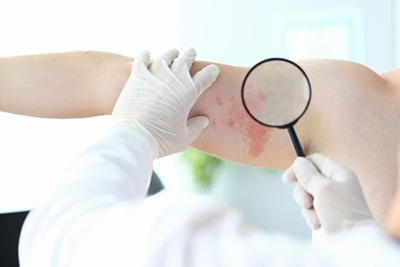
Some rashes show up as red, itchy patches. Others look scaly, swollen, or blistered. That variety is why dermatologists take a close, methodical approach. At Scott Sanders Dermatology, we always conduct a careful skin exam. The team looks at color, shape, location, and texture, all of which provide clues about what’s going on.
It’s not always obvious from appearance alone. Two patients could have similar-looking rashes caused by completely different things, say, an allergic reaction versus a fungal infection. That’s where experience and deeper diagnostic tools come in.
When Patch Testing or Biopsies Make Sense
For rashes suspected to be caused by allergies, patch testing helps identify which substances trigger a reaction. It’s a process in which small amounts of allergens are applied to the skin to see how it responds over a few days.
If the rash doesn’t fit into a clear category, or if there’s concern about something more serious like skin cancer, a biopsy may be recommended. That means taking a small sample of skin for lab analysis, something Dr. Sanders, Dr. Maydan, and Dr. Iyer handle with precision and care.
Tailoring Treatment to the Cause
Once the cause is clear, treatment at our New City, New York, office depends on what’s driving the rash. For inflammatory conditions like eczema or psoriasis, prescription creams, oral medications, or light therapy may be used. If infection is the culprit, bacterial, fungal, or viral, targeted medications clear it up.
For allergic reactions, avoiding triggers is key, but dermatologists also provide symptom relief with antihistamines or corticosteroids. At Scott Sanders Dermatology, our objective is results that last, not just covering up symptoms temporarily.
Why Early Diagnosis Helps
The sooner a rash is evaluated, the easier it usually is to treat. Waiting too long can lead to complications like skin thickening, pigment changes, or secondary infections. For anyone in New City, New York, dealing with a rash that isn’t improving, or one that seems to be getting worse, the team at Scott Sanders Dermatology is equipped to sort things out quickly and get treatment underway. Call the office of Dr. Scott Sanders, Dr. Elena Maydan, and Dr. Shilesh Iyer at (845) 499-2017.
- posted: Jul. 24, 2025
At Scott Sanders Dermatology in New City, New York, we help a lot of people with skin rashes. From sudden allergic reactions to chronic conditions like eczema, figuring out what’s behind a rash isn’t always as simple as looking it up online. Dr. Scott Sanders, Dr. Elena Maydan, and Dr. Shilesh Iyer work to get clear answers and choose the right treatment, without wasting time on trial and error.
Why One Rash Doesn’t Look Like the Next
Some rashes show up as red, itchy patches. Others look scaly, swollen, or blistered. That variety is why dermatologists take a close, methodical approach. At Scott Sanders Dermatology, we always conduct a careful skin exam. The team looks at color, shape, location, and texture, all of which provide clues about what’s going on.
It’s not always obvious from appearance alone. Two patients could have similar-looking rashes caused by completely different things, say, an allergic reaction versus a fungal infection. That’s where experience and deeper diagnostic tools come in.
When Patch Testing or Biopsies Make Sense
For rashes suspected to be caused by allergies, patch testing helps identify which substances trigger a reaction. It’s a process in which small amounts of allergens are applied to the skin to see how it responds over a few days.
If the rash doesn’t fit into a clear category, or if there’s concern about something more serious like skin cancer, a biopsy may be recommended. That means taking a small sample of skin for lab analysis, something Dr. Sanders, Dr. Maydan, and Dr. Iyer handle with precision and care.
Tailoring Treatment to the Cause
Once the cause is clear, treatment at our New City, New York, office depends on what’s driving the rash. For inflammatory conditions like eczema or psoriasis, prescription creams, oral medications, or light therapy may be used. If infection is the culprit, bacterial, fungal, or viral, targeted medications clear it up.
For allergic reactions, avoiding triggers is key, but dermatologists also provide symptom relief with antihistamines or corticosteroids. At Scott Sanders Dermatology, our objective is results that last, not just covering up symptoms temporarily.
Why Early Diagnosis Helps
The sooner a rash is evaluated, the easier it usually is to treat. Waiting too long can lead to complications like skin thickening, pigment changes, or secondary infections. For anyone in New City, New York, dealing with a rash that isn’t improving, or one that seems to be getting worse, the team at Scott Sanders Dermatology is equipped to sort things out quickly and get treatment underway. Call the office of Dr. Scott Sanders, Dr. Elena Maydan, and Dr. Shilesh Iyer at (845) 499-2017.
Main Location
301 North Main Street, Suite 3,
New City, NY 10956
Office Hours
Monday
8:00 am - 6:00 pm
Tuesday
8:00 am - 6:00 pm
Wednesday
8:00 am - 6:00 pm
Thursday
8:00 am - 6:00 pm
Friday
8:00 am - 3:30 pm
Saturday
9:00 am - 12:30 pm
Sunday
Closed